Air New Zealand website update

Great news for CARES users flying Air New Zealand!

Though the CARES is approved for use with Air NZ, we have been canvassing the airline to update their child restraint policy online, to specifically mention CARES.  Today they have advised they will be doing so,  joining other local airlines such as V Australia and Qantas.

Slowly but surely it’s becoming easier for young families to travel safely, and we’re progressing one airline at a time, and are thrilled with this result. Well done Air New Zealand!  I’ll attach a link when it’s available.

Donna

CARES, tray tables, Qantas & Jetstar

I haven’t had any problems installing the CARES on Jetstar (I regularly fly domestic to visit family).

Sharon said: June 29th 2010 10:06 AM

Do you know if the cares harness goes under or over the tray tables on the jetstar planes (domestic flight) as I think their setup is a little different to Qantas planes

We flew Qantas with it last time and while we had to argue several times that it was safe to use as the hostesses had never seen them before we were finally fitted ok, lucky we took the letter from CASA with us!

Do you have any tips for getting the info on the booking and then not having to repeat yourself a thousand times at the airport and again on the plane

Many thanks

Donna @ Little Gulliver said: June 29th 2010 2:13 PM

Hi Sharon,

I haven’t had any problems installing the CARES on Jetstar (I regularly fly domestic to visit family). I’ve also listed the related Q&A, from the manufacturers website, at the end of this post.

That’s great that you were able to use it on Qantas. I’m sorry you had to be persistent though, that can be tiring! install_step2-150x100I have been using it for 2 years+, mainly on Qantas, Virgin Blue and Jetstar. I would say I have had no problems. When boarding I explain I have a CARES harness & I carry the CASA letter with my boarding pass. If they look bewildered I explain that it is fully CASA/FAA approved & show them the letter. I suggest that I will install it and invite them back to have a look at it then. Once they see it they have been fine (even complimentary) about it.

I would say though that the recognition with the flight crew is certainly improving. I have been told the flight crew are trained on its use, but it depends on when they last did the training etc. Also, we’ve successfully worked with Qantas to update their website, which now specifically mentions CARES. This can be seen here under Child Restraint Devices; http://www.qantas.com.au/travel/airlines/travelling-with-children-infants/global/en. Your next Qantas flight should be easier!

With relation to Jetstar, we recently had a Little Gulliver customer phone us, after some frustrating Jetstar phoninstall_step3_2-150x100e calls. She was wanting to get the CARES listed on her flight booking, as you have mentioned. So, we put it to the test and phoned ourselves (we have a Jetstar trip coming up). We explained it is CASA/FAA approved and TOLD them to add it to the booking as we WILL be using it. This may sound a bit harsh, but as it is fully approved I feel confident in doing this. So, I guess my tip is to sound confident, stress that it is fully approved, manufactured by Amsafe and that you will be using it. Please add it to the booking! Having said that, I’ve used it and never (until now) had it added to the booking. But I can see that it could make it easier.

There is a happy ending though. We canvas the airlines regularly about updating their policies and websites to get the information out there and make life easier for us all. Jetstar has been our main focus in previous months and there is some good news coming up!  Watch this space.install_step3-150x100

Finally though, I have generally been able to use CARES without flight crew barely giving it a second glance. Sometimes I think their main concern is doing their final check (before takeoff) and noting that the waist belt is done up and that our bags are stowed correctly!

I’ve waffled a bit, but I hope it helps & let us know how you go. Comments from other users most welcome.

Regards,

Donna

Here’s a copy of a Q&A on the Kids Fly Safe website. It can be located at http://www.kidsflysafe.com/faqs;

Q. Does CARES affect the operation of the tray behind the child’s seat?

A. No. Ensuring that CARES did not adversely affect the functionality of the tray was an important FAA criterion for certifying CARES. The tray is lowered only while the red webbing loop is adjusted around the seat, and then is closed and locked in place, covering up the CARES loop. CARES does not affect the functioning or use of the tray. Using the tray doesn’t affect the safety or functioning of the CARES restraint.

In some older style seats found occasionally on small planes, the tray fits into a plastic cavity with recessed sides. In these the CARES red loop, when pulled taut, could prevent the tray from closing securely. In this case, the CARES loop should be installed around the seat and OVER the stowed tray for taxiing, take off, and landing. (See FAA Advisory Circular 120-87B “Use of Child Restraints on Aircraft”, which can be found in the “In-flight Documents” section of this website http://kidsflysafe.com/instructions/in-flight-documents/)

Installing a CARES – step by step guide

The tray table behind your child’s seat is lowered while installing the CARES. After the red strap is in place the tray table can then be closed again, over the strap. Its doesn’t impede the use of the tray table at all!

Kylie said: June 28th 2010 8:37 AM

Hi

I am very interested in the CARES travel harness for my 2 yo. However it looks like the harness would effect the lowering of the tray for the passenger seated behind my daughter. Is this a possibility or has this been taken into account in the design?

Donna @ Travel Toddler said: June 28th 2010 2:42 PM

Hi Kylie,

Good question, it does look like it could effect the tray table & you’re not the first to ask! Actually, you do lower the tray table behind your child’s seat while installing, as you suggested. After the red strap is in place the tray table can then be closed again, over the strap. It actually doesn’t impede the use of the tray table at all and has been extensively tested by the manufacturer.

I’ve included a step by step installation guide below, with some photo’s. I’m hoping the photo’s make it easier to understand than my rambling!

Also, you may be interested in a previous post which shows video of how it is installed. It can be viewed here.

Step One:
Seat your child in the aeroplane seat they will occupy.
Step Two:
Lower the tray table behind your child’s seat.
Step Three:
Slide the RED LOOP of the CARES restraint over the seat back, adjust the height of the RED LOOP so it is just above your child’s shoulders and tighten it. Then close the tray table (covering the Red Loop).
Step Four:
Place the BLACK SHOULDER STRAPS over your child’s shoulders. Slide both ends of the aeroplane seat belt through the loops at the bottom.
Step Five:
Buckle the seat belt and pull it snugly across your child’s lap, as you normally would do. Then buckle the chest clip (adjust the height – so it fits comfortably over your child’s chest if necessary).

That’s it, the CARES is installed! CARES is recommended for kids in their own seat weighing between 10 – 20 kilos and up to a metre tall. It is certified for used during all phases of flight; taxiing, take off , cruising and landing.

Anything I’ve missed or any other comments are most welcome.

Regards,

Donna

Top Family-travel Guidebooks

As an avid reader and armchair holiday maker, I am always keen to read the latest on travelling with kids. I look forward to the latest editions of family travel magazines such as ‘Out & About with Kids’ (see Little Gulliver in ‘Whats Hot’ p24 Winter 2010) and ‘Holidays with Kids’. Still, there is nothing like a good book to go through – marking pages and using them as a base for some further research and bookings. I rarely travel anywhere without at least one guidebook! I find they are a great starting point if you need a map or ideas during your stay. They are also great to go through at night with some brochures you’ve picked up (you’re able to check for advice – is that fort really as good as it sounds and does it have an atm)?!

The following are two of my favourite family travel companions. (Both are available for purchase from the Little Gulliver Book Shelf at www.LittleGulliver.com.au).

Please let me know if you’d like any more information about the topics in these books. This week I was able to help (and envy) a customer looking into child-friendly restaurants in London!

CARES for Special Needs Kids

If your child has a disability that requires hauling a brace to provide upper body support in an aeroplane seat, you know what a hassle it is to make arrangements months in advance with the airline.

Are you Flying with a child who has Special Needs?

If your child has a disability that requires hauling a brace to provide upper body support in an aeroplane seat, you know what a hassle it is to make arrangements months in advance with the airline. And you have to do it again before each subsequent trip! Check with your child’s physician or physical therapist to determine if the CARES child aviation restraint provides sufficient upper body support for your child. If it does – no more having to make arrangement weeks or months in advance with airlines because CARES is already certified for kids 10-20 kilos for all phases of flight. So, just book your flight, carry your CARES on board in your pocket or purse, install it on any seat in one minute. And know that your child is secure for taxiing, take off, turbulence and landing.

Is your Special Needs Child larger than 20 kilos and taller than 1 metre?

If so and if CARES provides sufficient upper body support (check with your physical therapist or physician) you can still use CARES. In the USA, the FAA has approved the use of CARES with special needs children as long as the child sits in a seat where no one behind him/her would have to brace against it in the event of turbulence. Effectively, this means the row in front of the bulkhead – the last row of any section of the plane. Australian CASA guidelines generally reflect those of the FAA. So if CARES is suitable for your child – remember to book the last row and install the CARES on any seat in that row.

For more information:

We have found CARES has brought great relief and has been successful in making travel easier for many Australian families with a special needs child. Remember though, CARES does not have a crotch strap which has meant it may not be suitable for some children. For more information or to discuss if CARES may be suitable for you, please contact us. We welcome your comments.

Please note, some information for this post was sourced from www.KidsFlySafe.com. And for more great kids travel items and purchase of CARES in Australia / New Zealand please visit our online store at www.LittleGulliver.com.au.

Fluoride in water

Laura said: June 25th 2010 1:25 am

I live in Indonesia and buy bottled water for preparing formula. Should I be supplementing with fluroide, and from what age? My son in 8 months old and gets perhaps 33% of his nutrition from formula, 33% breast milk and 33% solids.

Thanks!

Donna @ Little Gulliver said: June 25th 2010 1:48 pm

Hello Laura,

There is certainly much debate on fluoride! Where we live in Victoria, Fluoride is supplemented in our water. For you, I suggest seeking professional medical advice. This will ensure that your child is receiving an adequate amount of fluoride, based on your own circumstances. I’ve included a link to questions on Fluoride from our local government Better Health website, however it is not specific to babies and should be seen as a general guide only.

I guess your son will be crawling around soon and keeping you very busy – enjoy!

Regards,

Donna

Link to the Victorian Government Better Health Website;

http://www.betterhealth.vic.gov.au/bhcv2/bhcarticles.nsf/pages/Dental_care_fluoride

An excerpt;

Q: I live in an area of the state which does not have fluoride added to the water supply. What do you recommend for alternative preventive care, especially for young children?

A: Fluoride is a naturally occurring element that is found in rocks, soils, water and plants….Fluoride supplements, including tablets and drops, are recommended only for those children at high risk of dental caries in a non-fluoridated area, and only under professional advice from your dental therapist, dentist or from Dental Health Services.

Disclaimer

This answer provides general information. It is not intended to take the place of medical advice. Please seek advice from a qualified health care professional.

Travelling to Australia

Rachel said:  Friday, 18 June 2010 9:02 PM

Im just looking for some information on going to australia with my 3 year old son and partner.We are looking to go for 3 months do you have any information on visas and what way it works with getting one for the child.

Donna @ Travel Toddler said: Sat 19/06/2010 8:32 PM

Hi Rachel,

The 3 month getaway you are planning sounds wonderful!

To start with, there are some general topics on ‘immigration’ and ‘about Australia’ available at the Australian Government website http://australia.gov.au/. Also, when visiting Australia there are a number of different visa options, depending on where you are travelling from. For instance, if you were travelling from the UK, either an ‘evisitor’ or ‘tourist visa’ may apply. Our Immigration Department has a ‘Visa Wizard’ which may help you to see which visa may be relevant to your family. It is located on the Department of Immigration website at http://www.immi.gov.au/visawizard/. Another great resource to help you begin planning your holiday is the official tourism website http://www.australia.com/.

If you have any specific questions let me know, otherwise I hope you’ve found this information useful. Good luck with your travel plans and I hope your trip is a memorable adventure.

Regards,

Donna

NTSB supports Aeroplane Child Restraints

The National Transportation Safety Board (NTSB) today issued a Safety Alert to advise parents of the dangers to young children on aircraft when not restrained in an approved child restraint system or device.

American NTSB Safety Alert urges parents to use Child Restraint Devices on Aeroplanes

May 28, 2010

The National Transportation Safety Board (NTSB) today issued a Safety Alert to advise parents of the dangers to young children on aircraft when not restrained in an approved child restraint system or device. The Safety Alert notes that preventable injuries and deaths have occurred in children younger than 2 years who were unrestrained.

Specific child passenger safety issues on aircraft include the likelihood that parents and caregivers may not be able to maintain a secure hold on a lap-held child during turbulence and survivable accidents. Additionally, unrestrained children have become separated from their parents during survivable crashes and parents were unable to locate them during the evacuation.

“As the summer travel season gets underway, the NTSB would like to remind families traveling with children that child restraints are the best way to keep youngsters safe – whether traveling by car or air,” said NTSB Chairman Deborah A.P. Hersman. “While the NTSB would still like to see a federal regulation requiring the use of child restraints on aircraft, we continue to recommend that, when traveling by air, all parents purchase an airline ticket for every child in the family and place each child in a size-appropriate restraint system to ensure that everyone travels safely.”

The Safety Alert can be found on the NTSB website here: http://ntsb.gov/alerts/SA_015.pdf. Additional information about past NTSB safety recommendations on child passenger safety on aircraft can be found on the website here: Child Passenger Safety in the Air and Automobiles.

CBS report – Safety for Lap Held Children

CBS Morning Show on airline safety for lap held kids on airplanes.

When you’re watching this – remember it is a US report. Lap held children in the USA are completely unrestrained. Infants on Australian aircraft are by law required to be held in a lap belt which is attached to the parents seat belt. The report they refer to is by the National Transportation Safety Board (NTSB). The CARES harness is suitable for children from 10 – 20 kilos and up to a metre tall.

Why Use a Walking Harness?

walking harness

Safety Harness, toddler leash, walking harness…there is certainly a lot of debate on what they are and why use one! They seem to fit into the same category as the play pen or the working mum – everyone has an opinion on them! I believe such things are at the discretion of the parents, where the best interests of the child can be taken into account.

When would I use one?

When children are smaller we instantly strap them safely into their stroller when out and about. As they get older or if a stroller may not be available (especially when travelling or when a new sibling arrives) a harness can be a great option. It can ensure they are never out of your sight, while getting some exercise and burning off some of that energy – even in a busy airport or street.

I am noticing their use around my local area is increasing. I don’t often go to a shopping centre now without seeing at least one 2 in 1 harness buddy in particular. And last week I saw a Bear 2 in 1 Harness Buddy walking down the street with a proud owner! Specifically, if a child is a wanderer, then that may be a good reason to use one more regularly. Perhaps you are pregnant and prone to being a bit woozy or have young ones aged close together (they often run in different directions)? Some parents like them while the child is learning to walk, to help avoid spills (but note, they are not manufactured for this purpose). The main reason to consider one is while travelling, even if it gets packed away when you get home.

Travel

Airports and amusement parks are the most common recommendations for use – and for good reason! I always find checking through security at a busy airport difficult, watching the kids while making sure your laptop doesn’t disappear and look out if you’re wearing metal…Also try and consider yourself in an unfamiliar environment, such as shopping centres, parks, and museums where you may be more interested in the Louvre rather than your child for a second (only a second)! We also have one child who likes to touch everything, especially when asked not to. A harness can give them an extra arms length without worrying too much about them attempting to remove the crown jewels.

What types are available?

If you feel uncomfortable about using one, then maybe you shouldn’t – but there are many types available. Harnesses are very subtle nowadays and much more commonplace. They are now disguised in fluffy toys, backpacks and wrist straps.

The 2 in 1 Harness Buddy by Goldbug is popular worldwide. It is a cuddly backpack harness which comes in a fluffy dog backpack2number of animal styles. It has an adjustable chest and waist strap, making it safe and secure and has a cute animal backpack with ‘tail’ leash. The leash is detachable, so kids can wear it as a pet or small backpack on its own. (And if your daughter is of the girly-girl variety, then the new Butterfly option has fairy-like wings which may be a hit). The pouch is fully lined, but quite small. It would fit a small drink, purse or wallet, snack, tissues, play jewellery, playing cards, pirate treasure etc. Depending on which variety you choose, the pouch has either zip or Velcro closures.
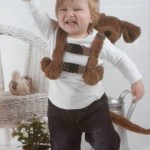
  • Price – RRP $AU 34.95
  • Age Group – 18 months +
  • Care – Fully machine washable

Safety Harness & Reins These are generally made up of an adjustable chest and waist strap. They are popular for l_safety harness and reins_largetravel, especially due to their compact size. There are similar options available across a range of brands, such as Dreambaby, Roger Armstrong, Safety 1st, Valco and Playgro to name a few. The differences to consider are how they attach and detach, the easier the better. Some also have adjustable anchor belts which are useful for securing your little one, especially when you’re eating out and may not have access to a high chair. Also, the harness is generally fixed in a loop and is not a single tether (as some other types of harnesses are) so check that you’re comfortable with the length.
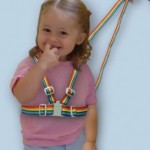
  •  Price range – between $AU 10 – 15
  • Age Group – toddler to preschooler

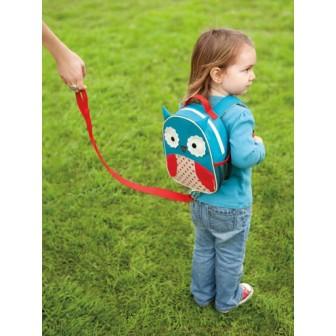
Backpack Harness These can be practical as they offer the ability to carry a little more of their own gear ‘on board’. owl-harness-lifestyle-webThe harness option can generally be tucked away or removed when not in use. It would be recommended for older children as the backpack adds a little bulk and weight. They are also a little harder to come by and more pricey, so consider how much use you’ll get from them.
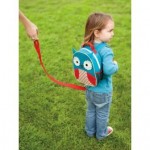
  • Price – over $AU 45 +
  • Age Group – preschooler +

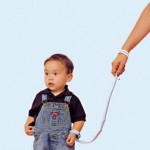
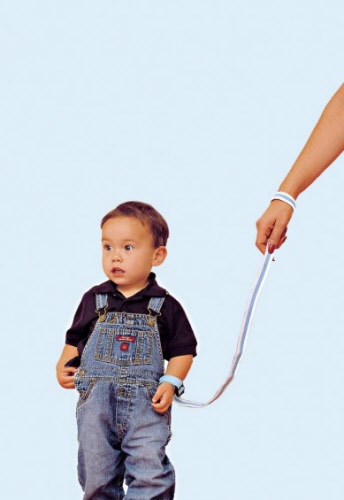
l_wristbuddy_largeWrist Strap There are a few options of this available (also see the Kinderkord below). One is the Dreambaby version which is a stretchy fabric designed for attachment on the carer and child’s wrist (called the Wrist Buddy). Handy if you’re not sure if you’ll need one as they can easily fit into a pocket or bag. It is also modestly priced with various colour options available.

  • Price range – $AU 8.95 +
  • Age Group – toddler +


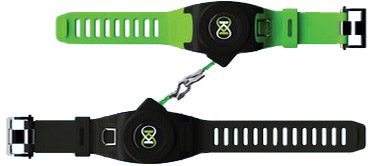
Kinderkord The Kinderkord is unique in that Velcro wristbands are attached to yourself and the child. They contain a pulley system which makes the leash retractable. So, they could be used to act as an extra pair of hands if you’re carting luggage or checking in at an airport or motel. And (it was invented by a mother of 2 sets of twins) you can attach multiples to your one wrist strap. My experience at Little Gulliver has seen this especially popular for families undertaking long haul flights, particularly to Europe. It is compact and has a more subtle look than some options. Some like it also for warmer weather, as the child doesn’t need to be wearing extra backpacks which may heat them up.

  • Price range – between $AU 30 – 35
  • Age Group – toddler +

kinderkord

Interesting Links

What is a walking harness, according to Wikipedia;

http://en.wikipedia.org/wiki/Child_harness


Some discussions on harness pros and cons;

http://www.bubhub.com.au/community/forums/archive/index.php/t-8404.html

http://answers.yahoo.com/question/index?qid=20100507224839AAbu9MA

Little Gulliver has an extensive range of walking harnesses;

www.LittleGulliver.com.au. See our ‘walking’ category here.

I’ve tried to write and consider all the options available in the walking harness category. If there are any I have missed, please let me know! I’d love to see some discussion from users too, what do you like and dislike about walking harnesses? It’s always helpful to others…